
Tennis
Why does tennis use 15, 30, 40? Explained!
We investigate why tennis is scored 15, 30 and 40. A scoring system which has been found to be rather weird and confusing to most tennis newbies.
published: 2024-10-30
Last updated: 2024-10-30

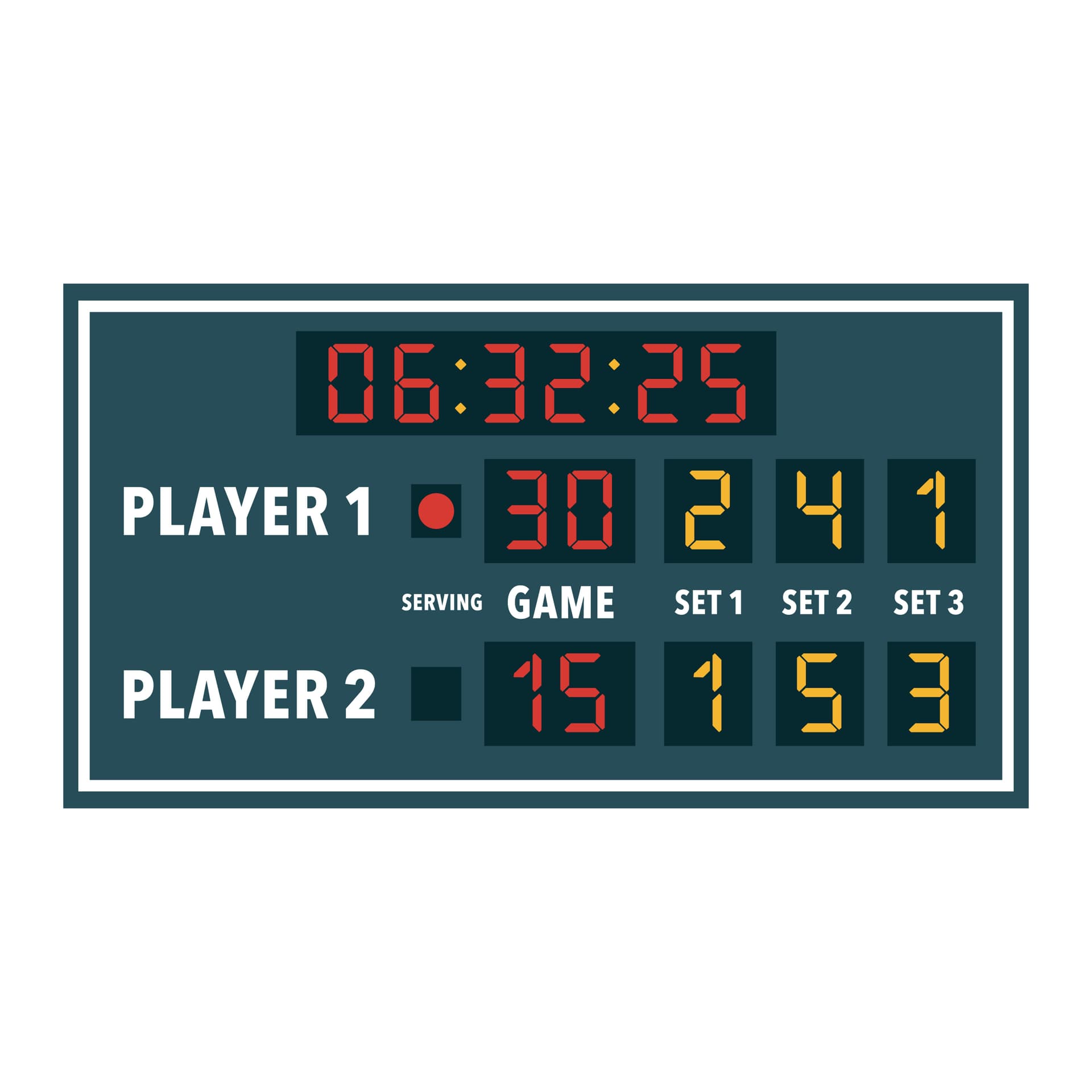
Image Credits: Bortonia// Getty Images
The reason behind tennis’ points system using 15-, 30- and 40 to denote scores is obscured behind an ambiguous historical veil.
No one can outrightly explain it without the ambiguity causing some sort of confusion. However, tennis scores, although seeming complex, are pretty much straightforward as you will see.
Having probably searched and traversed the internet trying to understand the complexities of this points system, you must probably still be confused. Here, we take a deep dive into explaining why tennis uses 15-, 30- and 40 as points for scoring, in the simplest fashion.
The origins of 15, 30 and 40 scores in tennis
Medieval France is generally referenced as the period where 15-, 30-, and 40 points originated from, with a 1435 ballad making mention of quarante sinq (“forty-five”), said to have given rise to 40.
There are other obscure theories of course such as text recorded in Latin in the form of a sentence saying, “we are winning 15, we are winning 30”, but the clock seems to be the most prominent, although it can be debunked as we will show here.
Moving the minute hand quarterly on clock faces to denote scores of 15-, 30- and 45 is perhaps the most logical of all the origin theories out there. It just makes sense if you investigate it clearly, but it’s still debateable because clocks in the 15th century measured only hours.
Jeu de paume another theory behind the scoring system
We find this theory to be more alluring than the others, perhaps because of some bias but it just hits different. The precursor to tennis, jeu de paume was played using the hand and was popular before the French Revolution.
Here’s where it gets interesting, crunch the numbers with us and you’ll see where our bias is derived from. The traditional jeu de paume court was 9- feet in length with 45 feet on each end.
A server moved 15 feet closer after scoring, another 15 feet after scoring again and an additional 10 feet after scoring the third. Now, we might be jumping the gun or drawing conclusions like conspiracy theorists, but that’s surely 15, 30 and 40, isn’t it?
It’s clear that the history behind the scoring system is contested and very ambiguous but there is a way to simplify this complex scoring system for the tennis novice. It does seem complicated at first sight but is straightforward as far as we see it.
Jeu de paume had over 1000 courts alone in Paris. That’s how popular the sport was during that era.
15, 30, and 40 scores explained in context
A tennis match works in three phases: a game, a set and a match.
Game: A game is played until a player wins by four or more points.
Set: A set is the collection of games played until a player wins six games or more.
Match: A match is played to the best of three or five sets.
How does scoring in tennis work?
The scoring system tennis uses is somewhat complex and often leaves newcomers confused. But once they have an understanding behind the fundamentals it becomes simplified.
Scoring in Tennis
| Set 1 | Set 2 | Set 3 | |
| Player A | 6 | 5 | 6 |
| Player B | 4 | 7 | 1 |

Tennis scores explored
Tennis scores explored
| 0 Points | Love |
| 1 Point | 15 |
| 2 Points | 30 |
| 3 Points | 40 |
| Tied score | All |
| 40-40 | Deuce |
| Server wins deuce point | Ad-in |
| Receiver wins deuce point | Ad-out |
With the above examples in mind, we will explain how the scores work to put 15-, 30- and 40 into context.
A game of tennis starts with both players at zero, which is known as ‘love’ in tennis jargon. The game is won when a player scores four or more points as follows: 15-, 30-, 40 and the match winning point.
From the second table we can see that 1 denotes 15, 2 denotes 30 and 3 denotes 40. That pretty much helps solve what might be a complex scoring system in the mind of a tennis novice without having to go all the way back to medieval France.
What does ‘love’ mean in tennis?
Love is the point or beginning of the game where both players are at zero points each.
Tennis scores are elaborate, but you’ll get it right eventually
The elaborate nature of tennis scores will make you feel like the players have been at it for hours on end with such big scores per point.
However, that is not the case. It is pretty much simple to determine the points without delving deeper into the historical context which not only confuses but is ambiguous and funny.
Even funnier is how 45 became 40, as per the many theories doing the rounds. We already mentioned a 1435 ballad, but this one will leave you in stitches.
Please trust that we did not make this up. It’s said that 45 was hard to say while playing so it was shortened to 40.
See how ridiculous it sounds, because why would players need to shout ‘45’ at the top of their lungs whilst striking the ball. Where were the umpires or score keepers of the time?
Scores of 15, 30 and 40 won’t confuse you, just keep it simple
We believe it to be as easy as 1,2,3. It is not that complicated if looked at from that angle. Whenever you come across a tennis scorecard just know that the numbers denote the figures we have up on the left column in our second table.
It won’t be easy at first, but once you understand the ins and outs, tennis matches will be much more exciting to watch, and you might just end up being a fountain of knowledge for the newbies.

Based in Johannesburg, South Africa, Jimmy holds a Diploma in Journalism and Media Studies. He’s a passionate sports enthusiast with broad knowledge across various disciplines.