
Cricket
How to Calculate Net Run Rate in IPL - Explained
Know how to calculate the Net Run Rate in IPL (Indian Premier League), the parameter upon which numerous teams’ qualification scenario depends ahead of the playoffs.

SportsBoom offers honest and impartial bookmaker reviews to help you make informed choices. While we may earn commissions through affiliate links, our content remains independent and free from promotional influence. For more information, see our Content Transparency and How We Review pages.
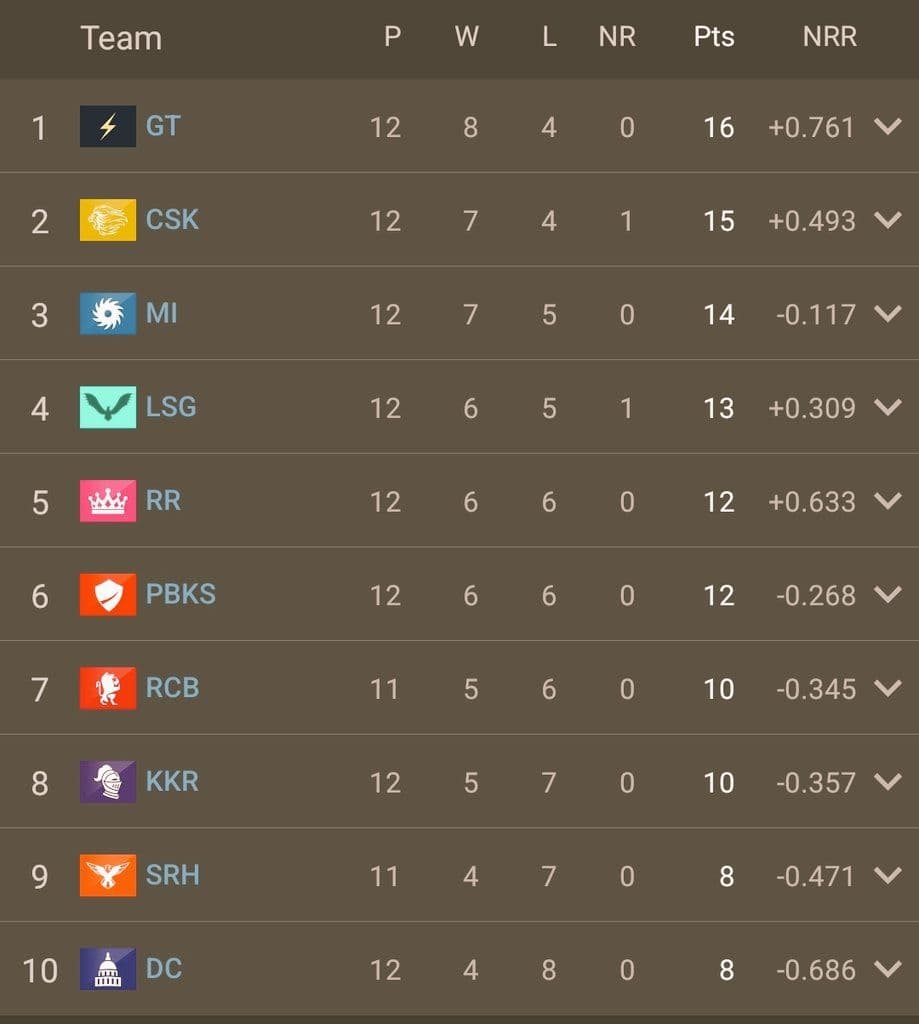
Since introducing the Net Run Rate (NRR) in international cricket during the 1992 ODI Cricket World Cup, it has become a standard tournament metric. Hence, when the IPL started in 2008, it followed the same parameters to conclude its league standing before heading to the playoffs. Below we will discuss how to calculate the net run rate in the IPL (Indian Premier League).
While round-robin and knockout tournaments have always been a rarity in international cricket, barring the four-yearly ICC tournaments, given that most teams play bilateral or tri-series throughout the year, the advent of T20 tournaments like IPL, PSL, BBL and more have made use of net run rate relevant throughout the year.
Very similar to what goal difference defines in football leagues across the world, cricket uses NRR to rank multiple teams on a table and comes in handy when two or more teams are level on points.
In cricket, the Net Run Rate is mostly used in limited-over formats like ODIs, T20Is and T10. Before the introduction of WTC (World Test Championship), there were hardly any league tournaments in Test cricket. With the number of overs played by a team holding very little significance in tests, NRR doesn’t have much use in the red ball format. The WTC points table calculation, however, is done differently.
What is NRR in IPL?
The definition of NRR (net run rate) is really simple. It is essentially the difference between two things - a team’s average run rates at which it is scoring runs and the average run rates at which it is conceding them. The “Net” in net run rate is the difference between the two.
Hence, an NRR is closer to an accurate indicator of how a team is holistically performing in a tournament or a series in terms of scoring and conceding runs. And NRR in IPL is using this calculator to rank teams as the league stages continue. One of the most competitive T20 tournaments in the world, hardly any team dominates in IPL as any team can beat the other and the race for the playoffs is often intense.
How do we calculate NRR in IPL?
It might seem too complex at first, but calculating the net run rate is as simple as a basic mathematical equation and can be used to evaluate any team’s performance. The Net Run Rate of a team in IPL is calculated by the following formula:
A team's Net Run Rate in a match is calculated by subtracting its average number of runs scored per over during the match from the number of runs it gave up per over during the tie. In other words, it's just that the team's run rate for the game minus the opponent's run rate.
Let's take a hypothetical example of an IPL match between Kolkata Knight Riders (KKR) and Chennai Super Kings (CSK).
Kolkata Knight Riders score 180/4 against Chennai Super Kings in their allotted 20 overs and then go on to restrict CSK to 162/4 in 20 overs. Now, the Net Run Rate (NRR) for the KKR team in this match will be calculated as follows:
NRR of Kolkata Knight Riders in this match = (180/20) − (162/20) = 9 − 8.1 = + 0.9.
So, the NRR for KKR for this specific match is +0.9. An NRR should always stay positive for a team to stay above their opponent when the points are tied.
NRR for Chennai Super Kings in this match = (162/20) − (180/20) = 8.1 - 9 = −0.9.
The Net Run Rate for CSK in this specific match is -0.9, which is in negative sign and indicates that the Chennai side scored at a lower run rate than KKR.
Now, to calculate the Net Run Rate of the team throughout an entire competition, one would use the same formula mentioned above in the provided information:
NRR of the entire tournament (KKR) = (Runs scored by the team / Total overs faced by the team) − (Runs scored by the opposition against the team / Overs faced by the opposition against the team)
The above formula would need to be cumulatively applied for all matches played by KKR in the tournament while taking into account all the runs scored and conceded in each match by the team.
Important things to note while calculating NRR
● When calculating Net Run Rate, the entire allotted overs are utilized and not only the number of overs in which a side was all-out. This happens if a team is bowled out before finishing their allotted overs.
● However, only the quota of overs faced by the side chasing the target is taken into account for calculation, i.e., if they manage to end the contest before the total number of overs allotted.
● A team's net run rate is determined by including only those games in which the desired outcome was reached. Hence, abandoned or postponed games aren’t counted.
How NRR decides crucial results: Example
A proper example of how NRR is used to decide crucial outcomes would be the 2019 World Cup. Both Pakistan and New Zealand stood on 11 points after their nine league matches. While the Kiwis saw their match against India getting abandoned due to rain, Pakistan also had to settle for a point for the same reason.
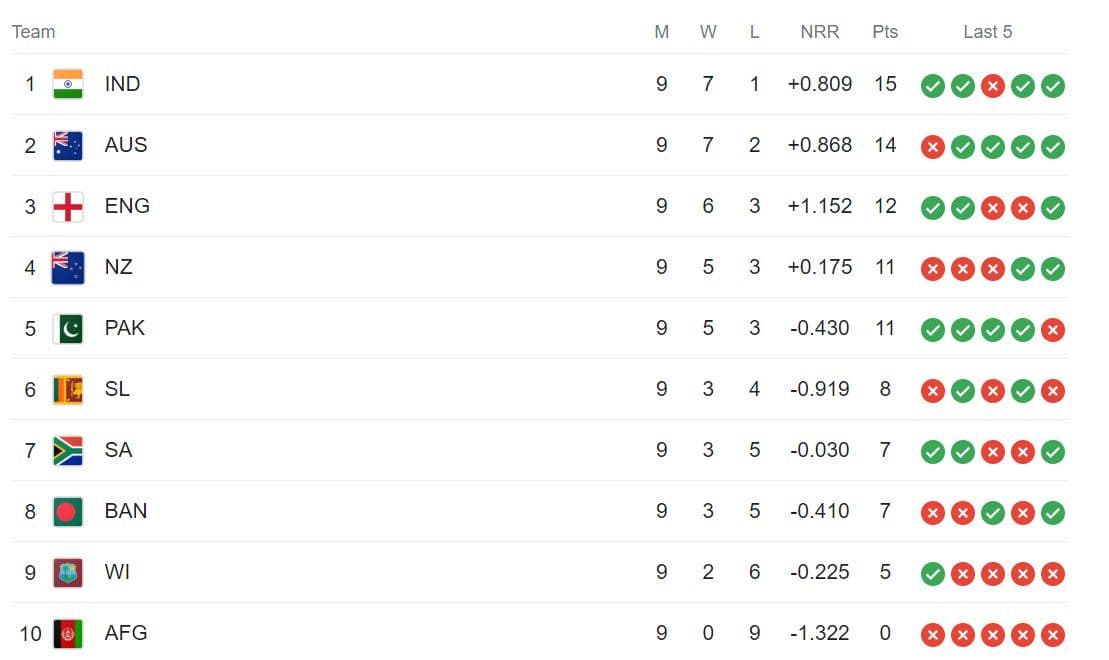
However, New Zealand stood fourth on the points table owing to their superior NRR of +0.175 leaving Pakistan to target a huge win against Bangladesh in their last league stage game. However, despite Pakistan giving an uphill 315-run target, the Bangla Tigers needed to score just eight runs to spoil Pakistan’s party, Eventually, Pakistan finished fifth with a negative NRR of -0.430.
How to Calculate Net Run Rate in IPL Points Table
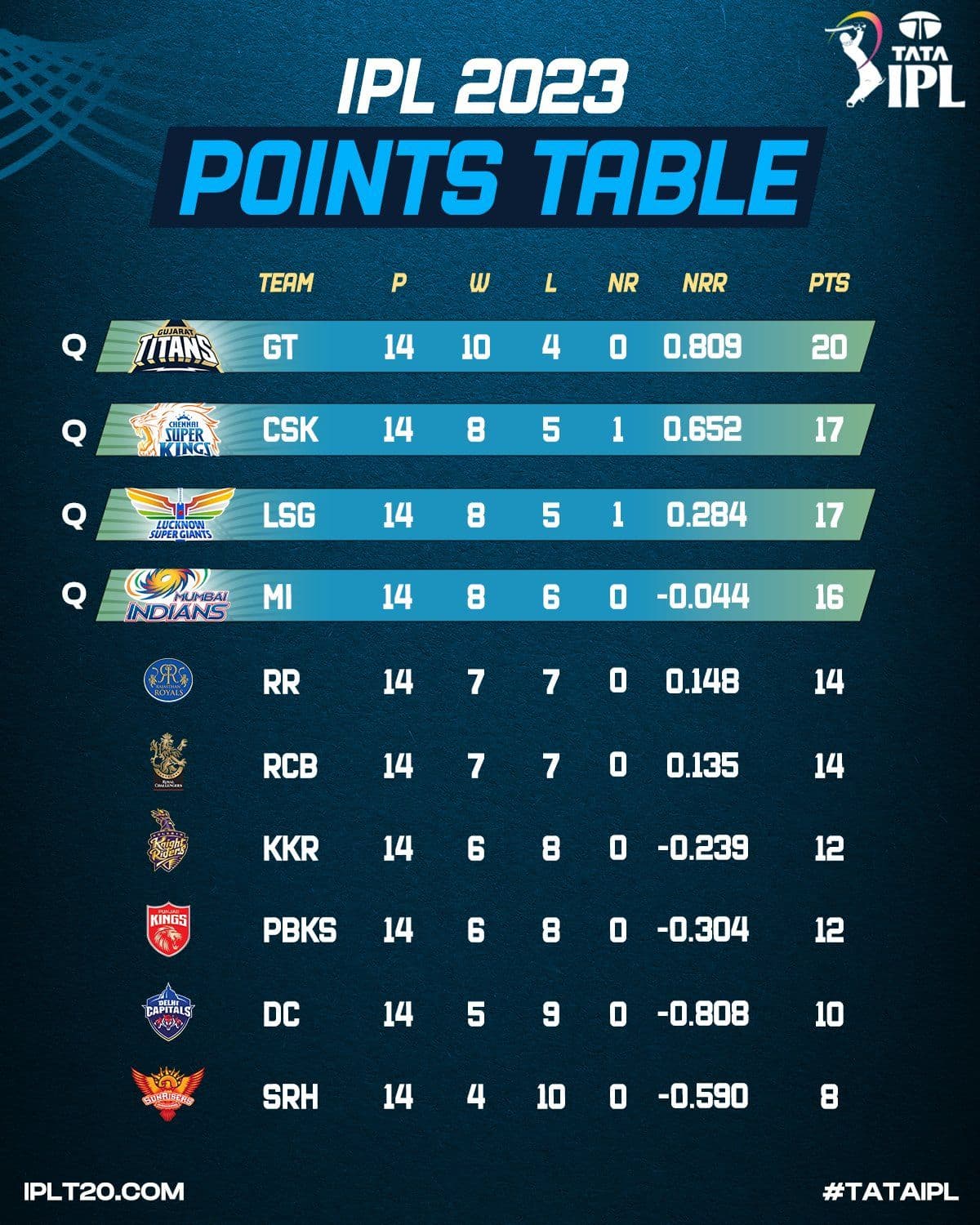
Let’s take a look at the IPL 2023 points table, where we can see Chennai Super Kings and Lucknow Super Giants sitting with 17 points after playing 14 league-stage games.
POINTS TABLE
IPL 2023
| Positions | Teams | Matches | Won | Lost | Tied | NR | Points | NRR |
|---|---|---|---|---|---|---|---|---|
| 1 | Gujarat Giants | 14 | 10 | 4 | 0 | 0 | 20 | 0.809 |
| 2 | Chennai Super Kings | 14 | 8 | 5 | 0 | 1 | 17 | 0.652 |
| 3 | Lucknow Super Giants | 14 | 8 | 5 | 0 | 1 | 17 | 0.284 |
| 4 | Mumbai Indians | 14 | 8 | 6 | 0 | 0 | 16 | -0.044 |
| 5 | Rajasthan Royals | 14 | 7 | 7 | 0 | 0 | 14 | 0.148 |
| 6 | Royal Challengers Bangalore | 14 | 7 | 7 | 0 | 0 | 14 | 0.135 |
| 7 | Kolkata Knight Riders | 14 | 6 | 8 | 0 | 0 | 12 | -0.239 |
| 8 | Punjab Kings | 14 | 6 | 8 | 0 | 0 | 12 | -0.304 |
| 9 | Delhi Capitals | 14 | 5 | 9 | 0 | 0 | 10 | -0.808 |
| 10 | Sunrisers Hyderabad | 14 | 4 | 10 | 0 | 0 | 8 | -0.59 |

Their positions are separated by the calculation of NRR (Net run rate), which crucially decides which team will play Qualifier 1 and which will take part in the Eliminator. The table standings for CSK and LSG were arrived at by the simple calculation of NRR.
The MS-Dhoni-led team had scored 2369 runs across 254.3 overs in IPL 2023 and conceded 2232 runs in 257.5 overs. Hence, their NRR stood at (2369/254.3) - (2232/257.5) = 0.652.
CSK’s total NRR were better than the difference between LSG’s total runs scored (2253 runs in 255.2 overs) and total runs conceded (2216 runs in 259.3 overs), which resulted in 0.284.
FAQs
What is the formula for net run rate in IPL?
Net Run Rate (NRR) = Runs scored by the team / Overs faced by the team - Runs scored by the opposition / Overs faced by the opposition team
Can your Net Run Rate decrease after winning?
A team’s NRR can decrease even after winning if they fail to maintain a current positive run rate.
How is the DLS run rate calculated?
If both teams had equal access to resources, the DLS approach determines the goal or results by calculating the runs scored by each team. To put it simply, the par score of Team 2 is equal to the sum of Team 1's score and (Team 2's resources / Team 1's resources).

An M.A. in English Literature, Subhayan is an experienced journalist and sports writer. Having worked as a journalist at Hindustan Times, Subhayan covered diverse beats including sports, education, and health, showcasing his versatility and in-depth understanding of various subjects.
Comments
0 comments
No comments yet. Be the first to share your thoughts!
Related Resources to Cricket
- T20 World Cup: Sanju Samson is ready to play as India's first-choice wicketkeeper, says Naman Ojha
- Nayan Mongia: I am surprised Rinku Singh, Ruturaj Gaikwad are not in the T20 World Cup squad
- Exclusive: Ian Bell confident English cricket is on the rise through young stars
- Saurabh Netravalkar: “It will be an emotional moment to play alongside some of my childhood teammates at the T20 World Cup”
- IPL 2024: Shivam Dube makes strong case for selection in T20 World Cup
- Exclusive: Capturing Cricket in India - Andy Brown’s Travelling Art Show
- India’s White Ball Spin Bowling Should Revolve Around Kuldeep: Murali Kartik
- [Exclusive] Unlocking the Journey of Kate Cross: A Champion's Tale in Women's Cricket
- Focusing on my Bowling, Want to Contribute as a Bowler Too: Ayush Badoni
- Pollard Commands Huge Respect in Mumbai Indians’ Dressing Room: Head Coach Boucher
- India is at a Disadvantage by Preparing Spin-Friendly Pitches Early On: Nick Knight
- Stuart Broad Laments the Decline of Test Cricket: While Rabada Features in Four Matches a Year, I Was Engaged in 12 to 15
- Player Contract is Essential to Play Cricket Full-Time in Netherlands: Bas de Leede
- How Many Bouncers are Allowed in an Over? Bouncer Laws in Cricket Explained
- Most Catches by Wicketkeepers in International Cricket: Top 15 List
- Highest Opening Partnership in PSL : Top 10 List
- Foreign Players in Each Team's Squad for Pakistan Super League 2024
- Pick a team that has played together for a long time for the T20 World Cup: Paddy Upton
- Cricket DRS: Rules, Methods, and Operation
- Best Bowling Average in ODI Cricket History