
Football
Best Footballers of the 1970s: Stats & Impact Ranked
The 1970s were one of the greatest technological developments and innovations in the footballing era, a time when South American teams were playing spectacular football, while European teams were playing a tactical kind of football. It was a time when tactics evolved, teams took to possession play, and legends like Johan Cruyff, Franz Beckenbauer, and Gerd Müller turned football into a spectacle. The sport became faster, more tactical, and went global. Broadcasting technology and colour television brought the World Cup to millions of homes and immortalised the spectacular football of Brazil in 1970 and the rise of Total Football in the Netherlands.
published: 2025-11-10
Last updated: 2025-11-10

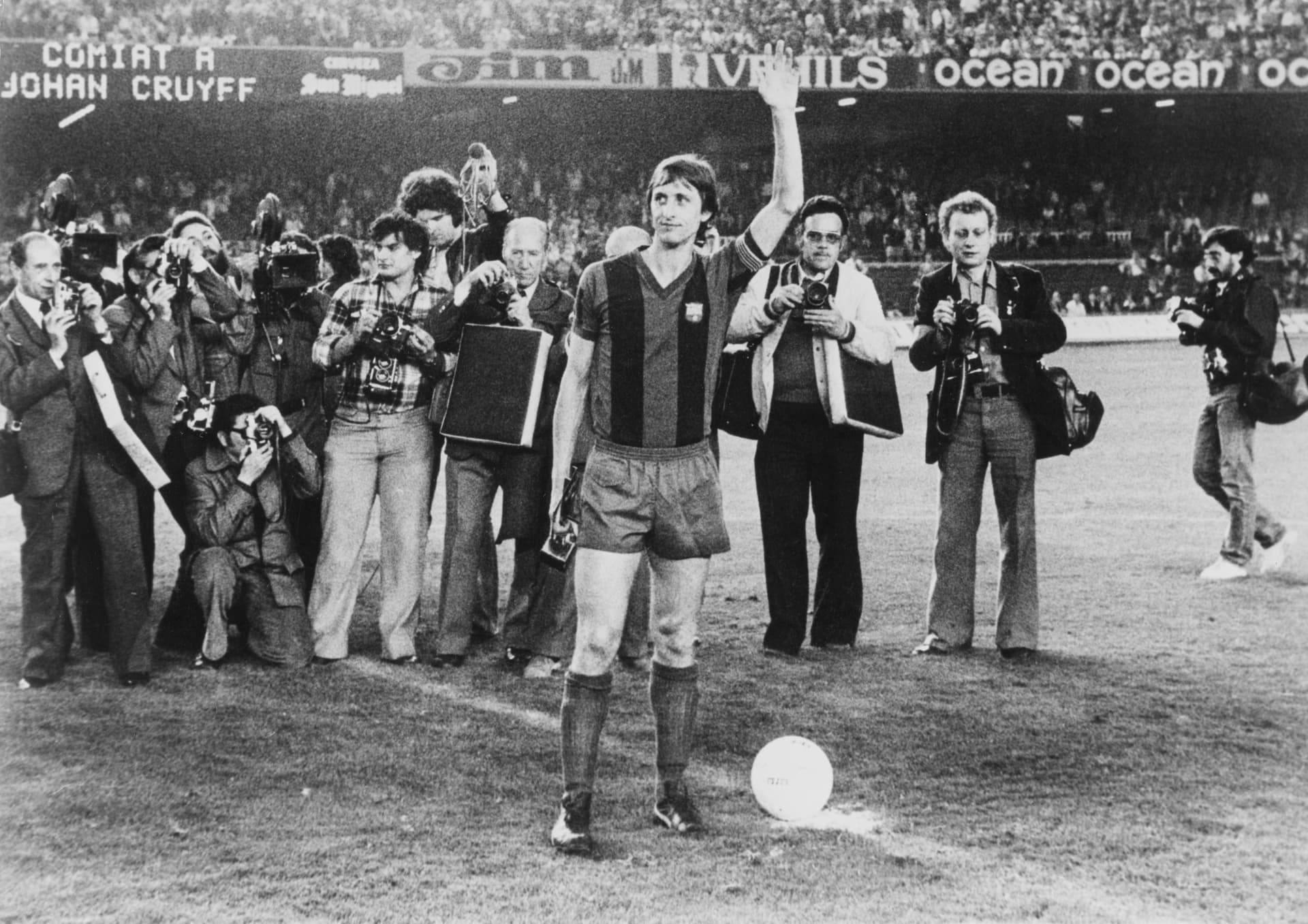
Photographers gather around the halfway line as Johan Cruyff (1947 - 2016)/Getty Images
This was also an era of contrasts: muddy pitches, heavy leather balls, and minimal substitutions, yet it produced some of the most talented and intelligent players in history. Perhaps because of this, footballers knew how to adapt everywhere. Footballers of the 1970s did not rely on advanced fitness programs or digital analytics, but simply on talent and a few tactical ensembles, not on the level of today.
In this article, we rank the best footballers of the 1970s and discover who the real king of the ball of that era is.
Industry Insight
The 1970s marked football’s transformation from raw athleticism to refined tactical brilliance. This was the decade that birthed Total Football, led by Johan Cruyff and Rinus Michels at Ajax, influencing global playstyles for generations.
According to GiveMeSport and other leading football analysis outlets, the decade’s stars like Beckenbauer and Muller defined positional evolution, with Beckenbauer reinventing the sweeper role and Muller embodying the pure striker archetype.
While Brazil continued to mesmerize under Pele’s twilight years, Argentina and the Netherlands emerged as tactical powerhouses. Clubs like Ajax, Bayern Munich, and Liverpool dominated European competitions, shaping the modern professional era.
Methodology
The rankings are curated based on expert football analysis from GiveMeSport, alongside international records, major tournament performances, and career accolades from the 1970s.
Evaluation Parameters:
- International Achievements: Major tournaments, titles, and key performances.
- Club Success: Domestic and European honours, goals, and appearances.
- Individual Awards: Ballon d’Or, Golden Boots, and tournament recognitions.
- Legacy & Impact: Tactical, cultural, and generational influence on the sport.
Primary Source: GiveMeSport
Additional References: Historical archives, official FIFA/UEFA records, and verified football databases.
SB Market Index Table
| Rank | Player | Nation | Club(s) of the 1970s | Major Honours (1970s) | Playing Role | SB Market Index |
| 1 | Johan Cruyff | Netherlands | Ajax, Barcelona | 3× European Cups, 3× Ballon d’Or | Forward / Playmaker | 98 |
| 2 | Franz Beckenbauer | West Germany | Bayern Munich | World Cup (1974), 3× European Cups | Sweeper / Defender | 97 |
| 3 | Gerd Muller | West Germany | Bayern Munich | World Cup (1974), Euro (1972), Ballon d’Or (1970) | Striker | 95 |
| 4 | Carlos Alberto | Brazil | Santos | World Cup (1970) | Right-back / Captain | 92 |
| 5 | Jairzinho | Brazil | Botafogo | World Cup (1970) | Winger / Forward | 91 |
| 6 | Kevin Keegan | England | Liverpool, Hamburg | 2× Ballon d’Or, European Cup (1977) | Forward | 90 |
| 7 | Johan Neeskens | Netherlands | Ajax, Barcelona | 3× European Cups | Midfielder | 89 |
| 8 | Mario Kempes | Argentina | Valencia | World Cup (1978 Golden Boot & Ball) | Forward | 88 |
| 9 | Dino Zoff | Italy | Juventus | UEFA Cup (1977), Euro (1968) | Goalkeeper | 87 |
| 10 | Sepp Maier | West Germany | Bayern Munich | World Cup (1974), 3× European Cups | Goalkeeper | 86 |

Johan Cruyff – The Maestro of Total Football
Johan Cruyff was more than just a player in the 1970s; he was the mastermind who redefined football itself. Ranked number 1 in the SB Market Index (98), Cruyff's dominance is evident in all three Ballon d'Or wins (1971, 1973, 1974) and in leading Ajax to an unprecedented three consecutive European Cups (1971–1973). Cruyff was the brains of the team, arguably the Dutchman who defined the era of the 1970s. A bohemian, visionary, and highly charismatic player.
The "Cruyff Turn" against Sweden at the 1974 World Cup became a global symbol of creativity and control. In the same tournament, he orchestrated the Netherlands' dream run to the final. In the same tournament, they dismantled Argentina 4-0 and Brazil 2-0, with a football so fluid that it changed the sport forever and influenced many tactics and coaches throughout history.
At Barcelona, he chose to carry on his legacy, leading the club to the La Liga title in 1974, the first in 14 years, and at the same time inspiring the identity of the club that has become a stronghold. Cruyff was the god of football; he is more than a footballer, we can all agree on that.
Franz Beckenbauer – The Kaiser
Franz Beckenbauer was elegance and authority on the football pitch, earning himself the nickname "Der Kaiser" (The Emperor) for his calm, imposing, almost regal presence. Ranked among the greatest players of the 1970s, he led West Germany to World Cup glory in 1974, defeating the Netherlands 2-1 in Munich. His fine control as a defender, combined with his revolutionary role as a "sweeper", allowed him to dictate the national team's play.
At club level, Beckenbauer captained Bayern Munich to three consecutive European Cups (1974–1976), an era of German dominance. His performances in those finals, particularly the 1974 replay against Atlético Madrid and the 1976 victory against Saint-Étienne, demonstrated his balance between tactical intelligence and impeccable technique.
After retirement, Beckenbauer transitioned into team management and led West Germany to another World Cup title in 1990, becoming one of the few people to win it as both a player and a coach. Off the pitch, he was known for his diplomacy, calm temperament, and visionary influence in shaping the reputation of German football worldwide, a highly respected figure in football. Until his death on 7 January 2024, Beckenbauer remained a symbol of footballing grace and intellect.
Gerd Müller – The Bomber of the Nation
As you can see, Germans love nicknames. Gerd Müller was the leading goalscorer of the 1970s, a striker whose instincts are very similar to those of Erling Haaland today, or vice versa. Known as “Der Bomber der Nation” (The Nation’s Bomber), he introduced this style of attacking football, that of impeccable positioning. Olivier Giroud said that he learned a lot from him. Müller’s record is staggering, winning the World Cup in 1974, European champion in 1972, and winner of the Ballon d’Or in 1970. What more can we say about him? Not to mention the numbers.
His most iconic moment came in the 1974 World Cup final, where he scored the decisive goal in West Germany’s 2-1 victory over the Netherlands, spinning into the box and finishing in one motion. Two years earlier, he had led West Germany to the Euro 1972 title, scoring twice in the final against the Soviet Union. For Bayern Munich, he was unstoppable, helping them win three consecutive European Cups (1974–1976) and becoming the Bundesliga's all-time top scorer.
Born in post-war Germany, Müller grew up in a modest Bavarian town, honing his finishing skills on rough country pitches. Off the pitch, he was humble and quiet, the opposite of his ruthless personality on the pitch. In an era before data analysis, Müller was pure intuition, a testament to the fact that true goal-scoring instincts cannot be taught, but are innate.
Carlos Alberto – Captain Perfect
Carlos Alberto Torres, as he is known, remains one of the most complete and elegant defenders in football, forever remembered as the captain who lifted the 1970 World Cup with the legendary Brazil team. His leadership and composure defined that golden generation, but his unforgettable goal in the 1970 World Cup final, the fourth in Brazil's 4-1 victory over Italy, became the most iconic moment in football. After a fascinating team move involving Pelé and Jairzinho, Carlos Alberto sent the ball into the corner of the goal.
Although he never played in Europe, Carlos Alberto became an international benchmark for the modern full-back. Calm in defense, technically gifted, and able to join attacks with precision. At Santos, alongside Pelé, he won several Campeonato Paulista and Copa Libertadores titles, before later helping the New York Cosmos popularize soccer in the United States in the NASL era.
Even without huge exposure to European clubs, Carlos Alberto's influence has crossed continents.
Jairzinho – The Hurricane of 1970
Jairzinho, nicknamed “The Hurricane”, was one of the vital forces behind Brazil’s triumph at the 1970 World Cup, a player whose speed, power, and finishing put a premium on the importance of a winger. During that unforgettable tournament in Mexico, he achieved a feat that no player has equalled before or since. He scored in every match from the group stage to the final. His goals against England, Peru, and Uruguay demonstrated his impeccable qualities, while his goal in the 4-1 final victory over Italy sealed Brazil’s third World Cup title and its place in history.
Playing alongside Pelé, Tostão, and Rivelino, Jairzinho was part of one of the most fluid and entertaining forward lines football has ever seen. At club level, he was a hero at Botafogo, where his athleticism and creativity made him a fan favorite throughout the 1970s.
After the World Cup, Jairzinho continued his career abroad, notably in France and later as a coach, helping to discover future stars, including the young Ronaldo Nazário in the 1990s. Jairzinho was a much-loved footballer around the world after the 1970 World Cup.
Conclusion
According to the SB Market Index, Johan Cruyff is the undisputed greatest footballer of the 1970s, scoring near-perfectly for both performance and influence. His achievements are undeniable: three Ballon d'Or titles (1971, 1973, 1974), three consecutive European Cups with Ajax (1971–1973), and a World Cup final appearance in 1974, where he inspired the Netherlands' revolutionary "Total Football". Cruyff was the philosopher of football.
On the pitch, his intelligence and movement transformed the game, while off it, his ideas reshaped football forever. His subsequent impact as coach of Barcelona in the late 1980s and 1990s laid the foundation for the modern tiki-taka style, creating generations from Pep Guardiola to Lionel Messi. Cruyff's legacy is not just about goals or trophies, but about vision. Without him, many of the concepts in football that we love today would not exist.
The 1970s produced extraordinary talents. Each was magnificent and certainly had a say in that era. However, none combined artistry and intellect as much as Cruyff.

With a strong background in journalism and years of experience in sports commentary, Dragoș Șoneriu has written about every aspect of sport, from match reports and features to tactical analyses and investigative pieces. A lifelong Arsenal fan, he dreams of seeing his beloved team lift the Premier League trophy. Outside of work, Dragoș collects anything football-related, from stickers and mugs to vintage shirts and scarves.