
Cricket
T20 Powerplay: Rules, Overs, and Strategies
The essence of T20 cricket lies in its powerplay periods, crucial phases that elevate the game's intensity and entertainment value. These have been unique to T20 internationals since the format's inception in 2005.


Image Credits: Getty
Cricket enthusiasts thrive on high-scoring games for the thrill, excitement, and increased audience engagement they bring to the sport. T20 cricket has emerged as a powerhouse in the cricketing world, garnering widespread popularity compared to longer formats, thanks in part to its high-octane, action-packed nature driven by the strategic T20 powerplay rules.
The essence of T20 cricket lies in its powerplay periods, crucial phases that elevate the game's intensity and entertainment value. These powerplays, unique to T20 internationals since the format's inception in 2005, are pivotal in driving the frequency of boundaries and the adrenaline rush they bring. Cricket fans eagerly anticipate these powerplay sessions, anticipating explosive moments and dramatic shifts in momentum right from the outset.
What is a Powerplay in T20 Cricket?
The power play is a strategic phase in a cricket match where specific restrictions on field placements are relaxed, providing the batting team with an opportunity to score more runs and gain an advantage over the fielding team. This phase comprises three distinct periods, with the first segment known as Power Play 1 (PP1) being particularly crucial.
PP1 spans the initial six overs in Twenty20 (T20) matches, introducing fielding restrictions that limit the number of fielders allowed outside the 30-yard circle. These restrictions encourage aggressive batting and dynamic gameplay as teams strive to capitalize on scoring opportunities.
Meanwhile, the fielding team focuses on taking early wickets to gain an edge. The power play phase often sets the tone for the rest of the innings, making it a strategically vital aspect of modern limited-overs cricket.
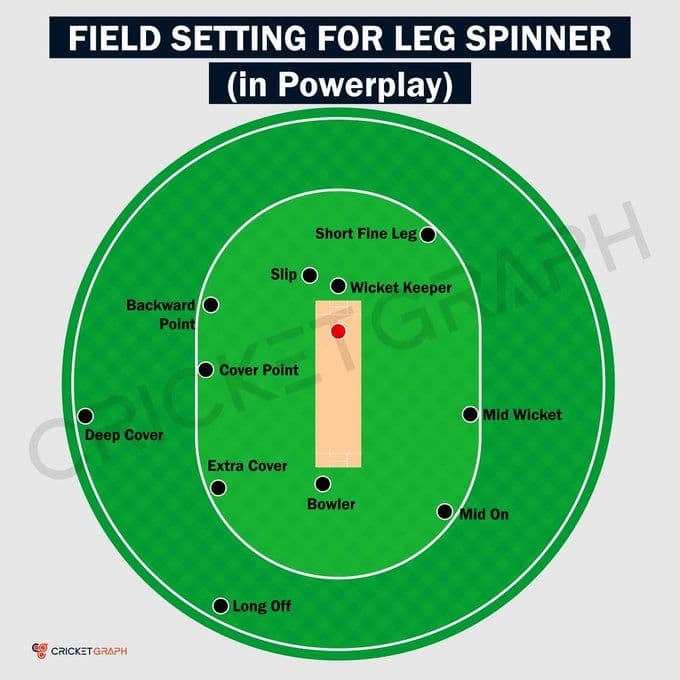
Image Credits: @CricketGraph (X Account)
Bowling strategies during powerplay in T20 cricket
While fielding restrictions lend obvious advantages to the batting side, it is not an absolute hopelessness for the bowlers either. Here are a few ways the fielding team can plan the powerplay period.
● Bowling effectively with a strategic approach is crucial during the powerplay overs in cricket. It's essential to align your bowling strategy with the field placements or adjust the field according to your planned line and length of deliveries. Aiming for a good, full length with outward swing increases the chances of inducing edges, providing opportunities for wicket-taking. Additionally, introducing an unexpected in-swing delivery targeting the pads or stumps can catch batsmen off guard, leading to breakthroughs.
● Field placement plays a pivotal role in containing runs during the powerplay. Misaligned fielding, such as having too many fielders on the offside while bowling to the leg side, can result in leaking runs. It's imperative to prevent easy singles and create pressure by setting up a strategic field placement that complements your bowling strategy. The objective is to make batsmen work hard for every run, thereby building pressure and increasing the likelihood of wickets falling.
● Taking wickets early in the innings is paramount as it can drastically alter the momentum and dynamics of the match in your team's favour. A well-thought-out field setup combined with disciplined bowling lines and lengths can significantly enhance your chances of taking wickets during the critical powerplay phase, setting the tone for the remainder of the game.

Image Credits: @joji_39( X Account)
Consequences of not following Powerplay rules
An important aspect to note is that failure to adhere to these fielding restrictions during the powerplay can result in penalties. If the fielding team exceeds the permitted number of fielders outside the 30-yard circle while a delivery is being bowled, the umpire will declare it a no-ball. This penalty grants the batting team a free hit opportunity on the subsequent ball, allowing them a chance to score runs without the risk of getting out, except via a run-out. It's a strategic advantage that teams must be mindful of during the powerplay phase in cricket matches.
History & Origin of Powerplay in Cricket
Fielding restrictions in cricket have evolved significantly over time, with notable developments starting in the 1970s, particularly during World Series Cricket. These restrictions were officially introduced in One Day Internationals (ODIs) in 1980 in Australia, initially allowing only two fielders outside the 30-yard circle during the first ten overs and later permitting five fielders for the remaining overs.
The concept of powerplays was formalized by the International Cricket Council (ICC) in 2005, dividing fielding restrictions into three blocks: a mandatory ten-over powerplay at the start and two additional five-over powerplays. However, teams often took both powerplays early, effectively creating a single 20-over block of restrictions. In 2008, the batting team gained discretion in choosing the timing of one powerplay to counter this trend.
Further ICC changes in October 2011 restricted the timing of the two five-over powerplays in a 50-over match and adjusted the number of fielders allowed outside the circle. From 1992 to 2012, the number of fielders allowed outside during non-powerplay overs changed, as did the requirement for catchers in the first ten overs. The ICC simplified the rules in 2015 by eliminating the batting powerplay and relaxing the restriction on catching fielders during the first powerplay. These changes have contributed to shaping the modern dynamics of limited-overs cricket.
Understanding T20 powerplay rules is essential for players, coaches, and fans alike to grasp the strategic nuances that shape modern limited-overs cricket. These rules, introduced in 2005 by the International Cricket Council (ICC), have evolved over time to enhance the balance between bat and ball while maintaining excitement and audience engagement.
The powerplay phase, with its fielding restrictions and strategic opportunities, plays a pivotal role in setting the tempo of a T20 match. It provides batsmen with a chance to score freely while challenging bowlers to adapt and strategize effectively. The consequences of not adhering to powerplay rules, such as penalties for fielding infractions, highlight the importance of discipline and tactical awareness on the field.
Overall, a deep understanding of T20 powerplay rules contributes significantly to the competitive and dynamic nature of modern cricket, enriching the viewing experience for fans worldwide.
FAQs
How many fielders are allowed outside the circle after powerplay in T20?
After the initial six overs, commonly known as the powerplay phase, a maximum of five fielders are allowed to be positioned outside the 30-yard fielding circle. This rule signifies a shift in fielding restrictions, introducing more flexibility for the fielding team while maintaining a balance between offensive and defensive strategies in T20 cricket.
Can 6 fielders be on the leg side in T20?
There can never be more than five fielders on the leg side at once. A maximum of two fielders may be outside the 30-yard line during the opening two overs. A maximum of five fielders may be outside the fielding circle after the first two overs.
How many fielders are allowed behind Square?
Because there can only be two fielders positioned behind square leg, it is uncommon to see more than five fielders on the leg side.
How many fielders are allowed on the onside?
There can only be two fielders behind the popping crease on the on side at the moment of the bowler's delivery, excluding the wicketkeeper.
Comments
0 comments
No comments yet. Be the first to share your thoughts!
Related Resources to Cricket
- Most Centuries In T20 International Cricket
- List of Top Players With Most Catches in IPL History (2008 - 2024)
- Identifying the highest wicket-taker in one IPL season
- How to Calculate the Follow-on in Test Cricket
- What is the Highest Score in T20 History?
- Top 10 best bowling figures in IPL history
- Who Is Mr. IPL? The Most Consistent Player in IPL History
- T20 World Cup: Sanju Samson is ready to play as India's first-choice wicketkeeper, says Naman Ojha
- Exclusive: The overdue rise of Proteas Test Player David Bedingham
- T20 World Cup 2024
- When is the 2024 T20 Cricket World Cup?
- Understanding No Balls in Cricket: A Complete Guide
- The Fastest Fifty in IPL History: A Record-Breaking Performance
- Top 10 Australian Fast Bowlers
- What is bio-bubble in IPL?
- Test Your Knowledge: The Essential Differences Between Red and White Cricket Balls
- Most Number Of Stumpings In IPL History
- IPL on hold. What does 'suspended' mean for the tournament?
- Mumbai Indians in the Playoffs: A historical look
- Understanding the Umpire's Bye Signal in Cricket
You might also be interested in

An M.A. in English Literature, Subhayan is an experienced journalist and sports writer. Having worked as a journalist at Hindustan Times, Subhayan covered diverse beats including sports, education, and health, showcasing his versatility and in-depth understanding of various subjects.